
the pretender
on ethical consumption, becoming, and the fucked up gap between who I am and who I'm supposed to appear to be

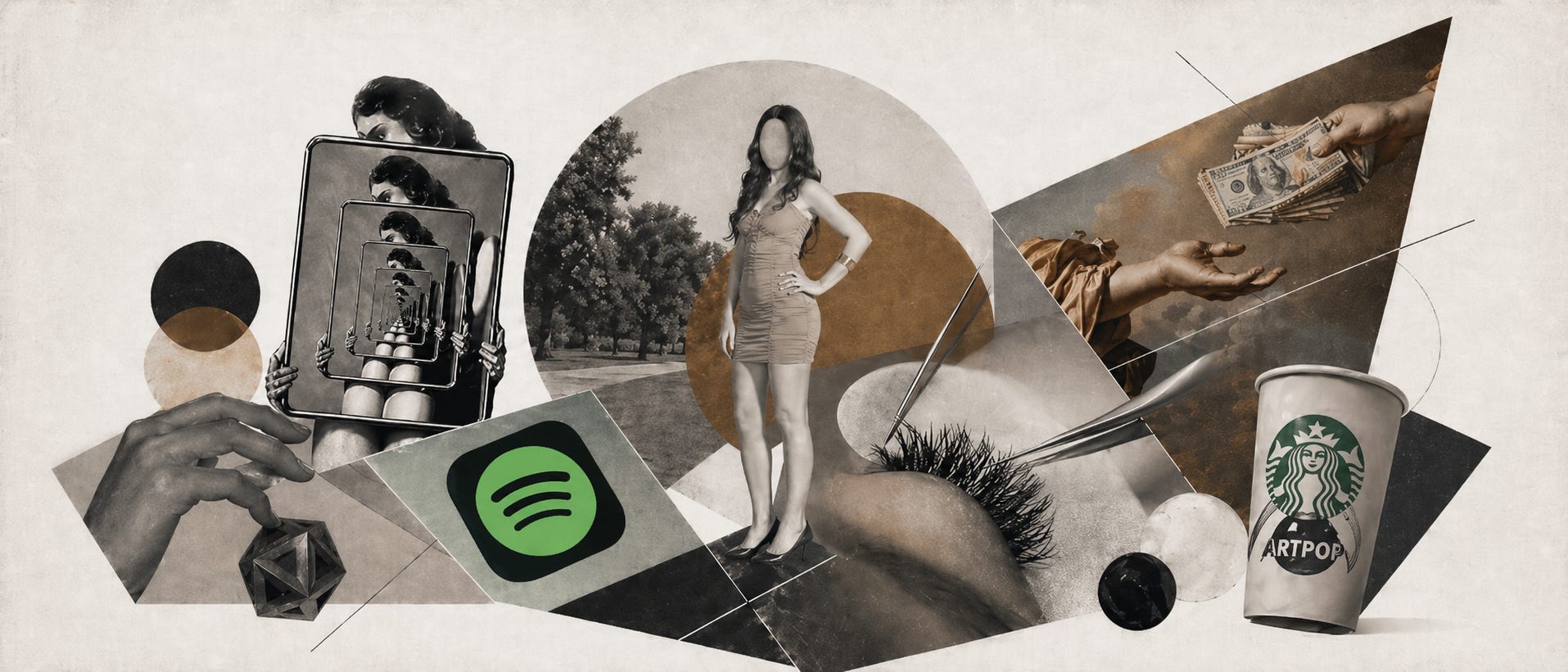
I recently paid for McDonald’s in cash because I didn’t want it to be traceable.
Not to the government. To myself.
At the time, it felt slightly ridiculous and completely rational. I didn’t want the digital footprint. I didn’t want the receipt. I didn’t want to revisit the choice later and have to account for it. I didn’t want to think about it later.
I thought about it later.
This is not a confession, exactly. It is also not a defense. I’m not writing to prove that I’m good, or pure, or ideologically pristine in every corner of my life. I don’t think that kind of coherence is available to most people, and I’m increasingly suspicious of anyone performing as if it is. This is more of a state of the union. A record of what has become harder not to see.
The instinct to hide the gap between what we believe and what we do has always been loud. As if the gap itself is the failure - rather than one of the most predictable consequences of being alive inside systems we didn't build.
I’ve spent a lot of my life trying to close the distance between who I am and who I’m supposed to appear to be. That training started early, as it does for a lot of girls.
I started wearing makeup at nine years old.
Some girls start with lip gloss, other girls start with eyeliner.
The first product I remember using was Clinique’s Perfectly Real Compact Makeup. Not technically a concealer, but I used it like one, specifically under my eyes.


I learned at a very young age that the self is something to manage. Adjust. Improve. Present. Sell back to yourself in a more acceptable form. Over time, that logic doesn’t stay on the face. It travels. Into clothes. Into food. Into politics. Into public identity. The object changes. The structure remains.
That was the beginning of a very long and expensive education in the gap between who I was and who I was supposed to appear to be - an education that would eventually cost me, conservatively, around $25,000 in eyelash extensions alone.
I’m not telling you that to perform guilt. I’m telling you because that number lives in my body differently now than it would have a few years ago. And understanding why is kind of what this whole piece is about.
By fifteen, I had added hair extensions and spray tans to the rotation. For years, I treated those rituals as maintenance. Even during law school, I got a spray tan every two weeks like clockwork. Every. Two. Weeks. The spray tan was non-negotiable.


It wasn’t vanity exactly - or maybe it was - but it was also just maintenance. The baseline. The thing you do before you leave the house so you can stop thinking about how you look and focus on everything else. That’s one of the cleverest tricks beauty culture ever pulled: it sells itself not as obsession, but as efficiency. Freedom, even. Just do this one thing, and then you can get on with your life.
COVID interrupted the ritual, and for a while I let it go. Then I picked it back up. And then, slowly, I just... stopped. I just started caring more about how I felt than how I looked. I started wanting to exfoliate without calculating whether my tan would come off unevenly. Small freedoms. Quiet ones.
I’ve been getting lash extensions since 2017 with very few interruptions. When I recently did the math on what I’ve likely spent over the years, it came out to somewhere around $25,000.
On lashes.
Now I want to be clear that I don’t think every personal expense should immediately be translated into how many hungry people it could have fed. That kind of moral arithmetic, applied universally, becomes a way of making everyone feel guilty for existing rather than interrogating the systems that create scarcity in the first place. But I do think the number means something. It tells me how deep the training went. How early I learned that my natural face was a problem to be solved.
I also want to acknowledge that I resisted some of it. I never got plastic surgery or filler during the years it was practically a social expectation. I'm not saying that to congratulate myself - I'm saying it because the resistance is part of the data too. The conditioning wasn't total. There were places I held the line, and I still don't fully know whether that was values, stubbornness, or just a different set of pressures winning out.
I don’t think I’m uniquely victimized by any of this, and I don’t think I’m uniquely guilty of participating in it. If anything, that’s the point. Modern life asks us to become both the product and the PR team. We are expected to monitor ourselves, optimize ourselves, package ourselves, and then call that empowerment. Conscience usually enters later, once the habits are already load-bearing.
That’s part of what I’ve been trying to think more honestly about lately: what it means to develop a conscience inside systems that train performance before reflection. What it means to wake up to the terms of your own conditioning after you’ve already spent years living inside them.
My relationship with my body has gotten more complicated this year in ways I’m still processing. For three months my mobility was completely halted before being diagnosed with an autoimmune disorder. I couldn’t move without being in unbearable pain. Now I am on medication and feel better, but my hair has changed in ways outside of my control, which has made the extensions feel different.. less like a choice I’m making and more like something I’m reaching for. There’s a version of me that finds that distinction important. I’m still figuring out why.
What I keep coming back to is this: I was nine years old when I decided my face needed covering. Nobody handed me that belief fully formed. It arrived in pieces, through a thousand small signals, until it felt like my own conclusion. And now, at this stage of my life, I am trying to have the same honest conversation about every other consumption habit I have - the brands I support, the platforms I use, the deals I take or don’t take - that I am slowly, imperfectly learning to have about my own face.
The work looks the same, actually. It’s just the mirror that changes.
So let’s talk about Starbucks.
Before October 2023, the iced brown sugar oat milk shaken espresso from Starbucks was basically part of my personality. I talked about it enough that people told me they had ordered it because of me. Then, Palestine was indiscriminately bombed by direction of the Israeli government in the name of self-defense, and I read that Starbucks was funding the violence, so I stopped buying Starbucks. At first, I didn’t do a deep dive on the specifics. I responded more instinctively than analytically. Communities I trusted were making it clear that this was a moment requiring solidarity, and I didn’t want to be aligned, even passively, with something that read as indifference.
I have not purchased from Starbucks since.
After seeing my peers partner with them for Coachella, I took a more careful look, and what I found was more complicated than the flatter narrative I had initially absorbed.
The SBWU - the Starbucks Workers Union - posted a statement in solidarity with Palestinians on October 9th, 2023. Starbucks sued them for it, claiming trademark infringement. Starbucks is not on the official BDS list. It has no stores in Israel. Its connections to Zionist investment are indirect - shared institutional shareholders, the kind that implicate almost every major company if you follow the thread far enough. The company’s official position is neutrality - which, on a question like this, functions as passive endorsement of the status quo. That part is real, and worth naming.
Some of the facts mattered. Some of the symbolism mattered. Some of the pressure had material grounding; some of it had that familiar internet quality where moral seriousness gets condensed into a few highly visible consumer choices and then treated as the whole story. What stayed with me most was not whether every single person boycotting Starbucks had the most disciplined political analysis. It was how certain companies become moral shorthand while others move through the world with almost no comparable scrutiny.
I have seen influencers take deals with Amazon. With Google. I have watched people promote Zara without even being paid for it, with barely a raised eyebrow from the same communities that made Starbucks a litmus test.
And I don’t say that to excuse Starbucks or to relitigate the boycott - I don’t regret participating in it, and I’ve developed a genuine distaste for large corporations that I don’t think I’m going back from.
I say it because the inconsistency is worth sitting with. Boycotts that emerge organically from community feeling are powerful and necessary. They are also susceptible to becoming more about visible performance of values than about material impact. Public ethics tend to cluster around what is most visible, most legible, most easy to point at. It is much easier to organize your moral life around a few symbolic brands than to grapple with the exhausting reality that exploitation is infrastructural.
And for people with public platforms, the whole thing gets even stranger. It becomes genuinely difficult to tell where conviction ends and social legibility begins. Not because one cancels out the other, but because they so often arrive together.
I can care sincerely and also be aware of perception. I can participate in collective action and still notice how unevenly moral attention gets distributed. I don’t think honesty about that weakens the politics. I think it’s part of growing up.
Spotify is harder.
I’ve been using Spotify since 2014.
The first song I ever saved was “Stay High” by Tove Lo.
Twelve years later, Spotify contains such a detailed archive of my listening life that it sometimes feels less like a platform and more like something I don’t know how to quantify: every song I played three times in a row at 2 a.m., every time I turned the volume up, the exact duration of every listen, every private mood translated into data and then and handing it back to me in the form of a Discover Weekly playlist that has, without exaggeration, altered the course of my life. Songs that found me at the exact moment I needed them. Artists I never would have encountered otherwise. A mirror of my own interior that gets more accurate every year.
That is not nothing. That is actually everything, for someone who is building a music project. For someone who believes that discovery is sacred.
And yet.
The criticisms of Spotify are not trivial either. The company has been criticized for how little it pays artists. Its leadership has often seemed more interested in scale than in music as an art form. There are investments in weapons. And most recently, ICE ads have been running across the platform, which for many people was the final straw.
There are broader questions too, about power, infrastructure, and what it means for so much of our cultural life to be mediated by a handful of giant platforms whose values do not necessarily align with the people who depend on them.
I’ve gone to Spotify events. I’ve received PR from them. I’ve written privately, and sincerely, that partnering with Spotify is one of my dreams.
So what exactly am I supposed to do with that?
I have been sitting with this question and I don’t have a clean answer. The twelve years of data Spotify has on me is not transferable. It’s not like a music library you can export. It’s an accumulated intelligence about who I am as a listener - and as an artist, that intelligence feels like part of my creative infrastructure. Losing it isn’t just inconvenient. It feels like losing something that’s mine, even though technically it’s theirs.
And maybe that’s exactly the point. Maybe that’s what extractive platforms do - they make themselves so load-bearing in your life that leaving feels like self-destruction.
I don’t know what I’m going to do yet. But I keep imagining a version of the internet that was built to know you that well and actually be on your side.
I think naming everything - the dependency, the dream, the discomfort - is more honest than pretending the choice is simple. It isn’t. And I’m tired of a culture that demands we perform certainty about things that are genuinely hard.
The same is true, maybe most uncomfortably, in the creator economy itself.
My largest goal right now is to build a music career and to invest in organizations that make the world a better place. And the way I am funding that dream - the way most independent creators fund their dreams - is through brand deals and social media. I do not come from money. I am not backed by a label. I have over $100,000 in law school debt that I pay for by myself, every month. I am someone trying to build financial stability through the platforms and partnerships available to me, so that I can do the work that will have the largest positive impact on the world.
I say that because it matters for the question I am about to ask. It is easy to have a clean ethics when the money is hypothetical. It is harder when the money is the bridge between where you are and where you are trying to go.
Which brings me to a thought experiment I have been sitting with for a while now, and I want to think through it out loud because I don’t think there’s a clean answer.
What is the ethics of taking a brand deal with a corporation that causes harm - and donating every dollar of it to the cause they are harming?
On paper it sounds almost elegant. The bad actor funds the resistance. You become a conduit, a kind of ethical money launderer in reverse. The cause gets resources it desperately needs. You get paid. Everyone wins, sort of.
Except.
The corporation doesn’t just get your labor. They get your face. Your credibility. Your audience’s trust, which you have spent years building through exactly the kind of honesty I’m attempting in this piece. A check to a good cause doesn’t undo the association. It doesn’t undo the post. It doesn’t undo the fact that somewhere in a boardroom, someone decided your name was worth paying for because of what it signals - and that signal now points, however briefly, in their direction. They purchase the trust between a creator and her audience. A donation may redirect the money, but it does not erase the role your face and voice played in laundering legitimacy.
But then again: the cause gets funded. Real, material good happens. People get help they wouldn’t have gotten otherwise. Is it not a little self-indulgent to protect the purity of your own image while a worthy organization goes without?
I keep thinking about who gets to make that calculation. If the deal is with a company that is actively harming a specific community, does that community get a say in whether your participation - even with good intentions, even with full donation - is acceptable to them? Or is that an impossible standard that would paralyze any action entirely?
I don’t know. But I do think questions like these deserve better public language than they usually get. Too much of our discourse swings between self-excusing pragmatism and purity theater. Neither feels especially serious.
I’ve felt versions of this same tension in smaller, stranger corners of life too.
For instance, I have not figured out how to eat with my friends yet.
Not in the way I mean. I sit across from people I love while they order McDonald’s, or eat meat without thinking about it, and sometimes I eat the meat too. I want to be clear about that - I still eat meat. I just can’t do it anymore without being fully conscious of what I’m doing. Something shifted in me after a racist political moment that was never meant to make me think about animal consciousness at all - the “they’re eating the cats and dogs” moment - and I cannot unshift it. I don’t fully understand why that was the thing that did it, and I’ve learned to stop requiring my own transformations to make sense.
What interests me more is the pattern. How often change begins not with a fully articulated ethic, but with a disturbance. A snag. A detail that catches in the mind and refuses to leave.
Sometimes I wonder what my friends think when I’m at the table eating the same thing they’re eating, having told them at some point that I was trying not to. I wonder if they’re quietly judging me, or quietly relieved, or not thinking about it at all because they have their own contradictions to manage. It’s a little like telling everyone you’re on a diet and then eating the cake at the birthday party. Which, for the record, you should absolutely do. The cake is there. It’s someone’s birthday. You are a person.
We like to imagine that people arrive at their values cleanly, through principle first and practice second. But often it happens in reverse. First there is the habit. Then the discomfort. Then the naming. Then, if we’re lucky, a gradual reorientation.
That’s where I find myself now. Not purified. Not resolved. Not above any of this. Just more aware of how many parts of life have been shaped by forces that ask us to confuse self-management with integrity.
And more aware, too, of how tempting it is to respond to that realization by trying to become flawless in public.
I’m not interested in that anymore.
What I want, or what I think I want, is a more honest language for contradiction. One that doesn’t treat every inconsistency as a moral collapse, but also doesn’t rush to excuse everything in the name of complexity. One that leaves room for political action, personal responsibility, structural analysis, and the humbling fact that most of us are trying to become more ethical using tools, instincts, and appetites shaped by worlds that did not particularly want that for us.
That is maybe the most honest thing I can say about all of this: the growth has rarely looked the way I expected it to. I started using a product called Perfectly Real to hide my real face at nine years old and spent the next two decades in various degrees of faithful service to a standard I never agreed to. I boycotted a coffee chain before I fully understood why. I paid for a burger in cash to hide it from myself. I have spent $25,000 on gluing fake lashes onto my real lashes while people go hungry and I have held that number in my hands and tried to figure out what it means and arrived, every time, somewhere more complicated than guilt.
The goal, I think, is consciousness. The willingness to keep looking at the gap between your values and your choices without looking away. Not to punish yourself into paralysis, and not to rationalize yourself into comfort, but to stay in the discomfort long enough to let it change you. Even when the change comes slowly. Even when it comes from a strange direction. Even when you’re still eating the thing while you’re thinking about it.
I care less about how I look these days and more about how I feel. That shift took longer than it should have, and it is still not complete, and I think that’s true of all of it. The consumption, the conscience, the becoming.
The mirror keeps changing. I’m still learning to look.
There are so many articles on ethical consumption, and yet so few that come to the unfortunate truth that the only real answer is to sit in the uncomfortable gap between values and action. I love how pragmatic this reads
God, THANK YOU for this piece!! Nuance is so difficult to parse sometimes, especially when we are living in so many sytems that cause harm. I struggle with it too. And it's like, there's no room to even have the conversation on how these things weight on both an individual AND systemic level.